
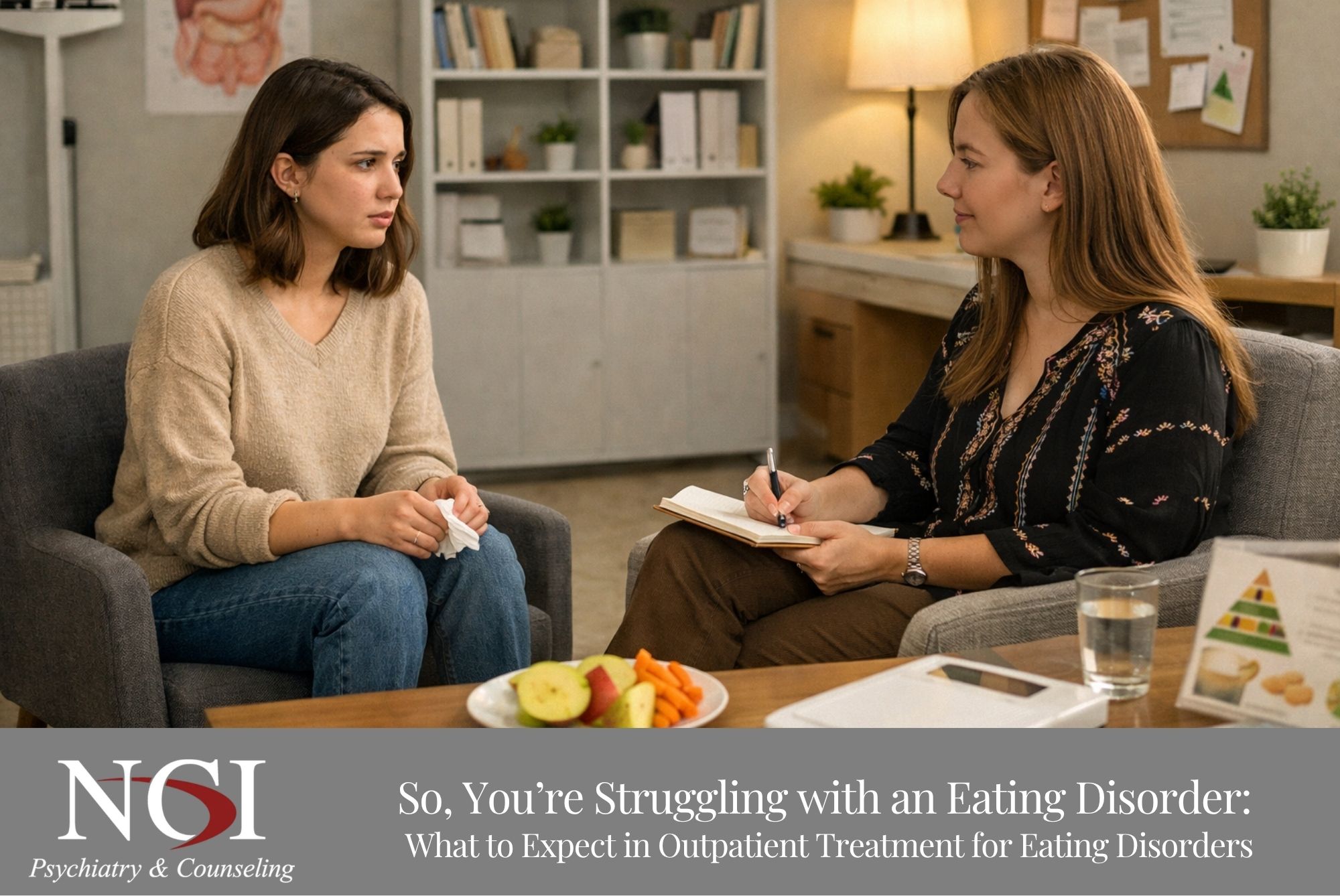
 In a world where diets, health foods, fitness culture, and GLP-1 ads are pervasive, it can be hard to identify what qualifies as disordered eating and what doesn’t. If you are experiencing a turbulent relationship with food and would like to work toward more peace in your relationship with food and your body, outpatient therapy for eating disorders may be right for you.
How do I know if I’m struggling with an eating disorder or disordered eating?
Do you ever question whether what you’re eating is good or bad? Are you constantly thinking about food? Do you avoid certain food groups because they might be unhealthy? Do you avoid certain foods because of their color, texture, or flavor? Do you have an intense fear of gaining weight? Do you have specific rules or rituals that you follow around food? Are you constantly comparing the way your body looks to how other peoples’ bodies look? Have you received information from your doctor that you may be underweight or overweight? Are you experiencing health complications due to vitamin deficiency or malnutrition? Are you experiencing symptoms such as brain fog, dizziness, frequent headaches, shakiness or fatigue? Have friends or family members expressed concern about the amount of food you eat? Do you feel the need to exercise, vomit, or use laxatives to make up for the calories you’ve consumed? Are you experiencing shame in your relationship with food and body?
If you are experiencing any of the above difficulties with food, it may be time for you to get an eating disorder assessment with a trained professional team. There are exceptions to every rule, and no single one of the above symptoms is necessarily indicative of an eating disorder. However, if you are experiencing multiple of these symptoms, or have general distressing or unkind thoughts toward your body or your relationship with food, this can indicate that an eating disorder is at play.
Luckily, therapists and counselors are here to help!
What can I expect from eating disorder treatment?
Eating disorders are complex and multifaceted. Because of their complexity, best practice for eating disorder treatment is to work with a multidisciplinary team of professionals with training in eating disorder treatment. A basic team is comprised of three clinicians: a doctor, a mental health therapist, and a dietitian. Other team members may include parents, medical specialists (such as a gastroenterologist, gynocologist, or endocrinologist), peer supporters, dentists, or occupational therapists.
A doctor’s role on the team is to monitor your physical health and stability for outpatient work. A doctor may conduct tests such as blood work and/or bone density scans (DEXA) to montior whether your physical health is improving with treatment.
A mental health therapist’s role on the team is to help you identify and process a myriad of behaviors, thoughts, beliefs, emotions, and values that come up in your relationship with food and your body. Licensed mental health professionals such as a Licensed Professional Counselor (LPC) or Licensed Clinical Social Worker (LCSW) hold master degrees in their respective fields and are overseen by a licensing board. They are qualified to work with eating disorders. Ask your therapist their level of comfort with working with eating disorders to help determine if they are a good fit for this type of work. Another qualification that some therapists may have is a Certified Eating Disorder Specialist (CEDS), which is a credential overseen by the International Association for Eating Disorder Professionals (iaedp). (Dietitians and doctors can also hold the CEDS qualification.)
A dietitian’s role on the eating disorder treatment team is to provide nutrition counseling, which may include assessing your nutritional needs, recommending meal plans, increasing or decreasing food intake as appropriate, and/or monitoring food intake. It is important to note that, like therapists and doctors, not all dietitians are trained equally, and some may not be qualified to provide eating disorder treatment. To ensure you’re working with a qualified professional, look for the RDN (Registered Dietitian Nutritionist) or RD (Registered Dietitian) credential. These are professionals with a master’s degree in nutrition and dietetics and are overseen by a regulating board. If you’re unsure of how to start searching for an appropriate dietitian, ask your doctor or mental health therapist to provide you with referrals to dietitians they recommend.
These three professionals will collaborate (with your permission) to ensure that you are receiving whole-body care during the recovery process.
In future blog posts, we will explore the some of the causes and perpetuating factors that contribute to the development of eating disorders, the prevalence of eating disorders and disordered eating, specifics about each of the eating disorder diagnoses (including pica, rumination disorder, anorexia, bulimia, binge eating disorder, ARFID, orthorexia, diabulimia, and other-specified eating disorder), what therapy and counseling looks like for those in eating disorder recovery, and further steps to take if your eating disorder is more severe and needs a higher level of care than the outpatient level.
How can I get started with eating disorder treatment?
Looking for eating disorder recovery help in Northwest Arkansas? I’m Lizzie Reimer, MS, LAC, and I am currently practicing at Northwest Counseling Inc. in Bentonville. I am working toward my CEDS and would be happy to come alongside you and support your journey to a healthier, happier relationship with food and your body. I work from a Health At Every Size (HAES) and Intuitive Eating (IE) perspective, and I utilize therapeutic interventions like person-centered therapy, narrative therapy, sand tray therapy, and EMDR (a type of trauma-therapy). If you’re curious about how to decrease shame and experience more peace and freedom in your relationship with food, call 479-855-5704 to get started!
Looking for additional resources to help you or a loved one through an eating disorder? Visit nationaleatingdisorders.org, anad.org, or eatingrecoverycenter.com to learn more about higher levels of care and what treatment modalities may be appropriate for you.
Contact Information
Northwest Psychiatry & Counseling
📍 Address: 701 N Walton Blvd., Unit 6, Bentonville, AR 72712
📞 Phone (Appointments): 479-855-5704